Snooker Best of 7 vs Best of 19: How Match Length Changes Upsets
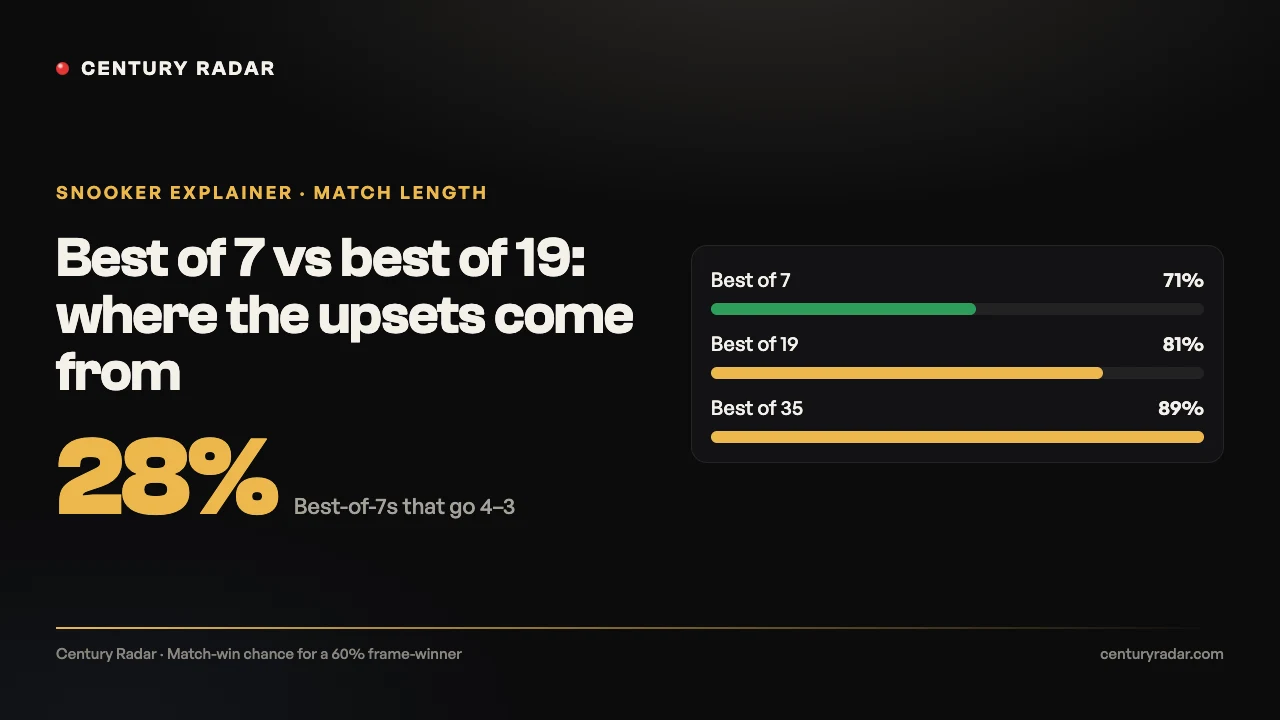
Every early round of the Northern Ireland Open is best of seven. When it starts in Belfast on 18 October, players will go from the last 64 to the quarter-finals in matches that can be over inside an hour. The quarter-finals are best of nine, the semi-finals best of 11 and the final best of 17.
Fans and players say the same thing about short matches every season: they are a lottery, and the favourite is one bad kick away from going home. The arithmetic agrees. The results tell a more interesting story.
What the arithmetic says
Take a player who wins 60% of the frames he plays against a given opponent. That is a big edge. Judd Trump, the best frame-winner among the players we track, has won 62% of his frames since June 2025. Treat every frame as a separate coin toss weighted 60–40 and count how often he wins the match:
- Best of 7: 71%
- Best of 9: 73%
- Best of 11: 75%
- Best of 19: 81%
- Best of 35, the length of a world final: 89%
So the same player, with the same edge, loses almost three best-of-sevens in ten and only about one world final in ten. Shrink the edge to 55% and best of seven gives him 61%, barely better than a coin, while best of 19 still gives him 67%.
The reason is room to recover. In a best of seven, two frames lost to a bad safety exchange and a missed black can be the whole match. In a best of 19 the same two frames are a blip in the second session.
What the scorelines say
The data backs up the arithmetic on how close short matches are. Of the 523 best-of-seven matches we have recorded since June 2025, 147 went to a 4–3 decider. That is 28%. Of the 89 best-of-19 matches, nine went 10–9, about 10%.
Short matches also produce the blowouts. 98 of those best-of-sevens finished 4–0, almost one in five. None of the best-of-19s ended in a whitewash. A player can have a bad half hour and lose four frames in a row; it is much harder to have a bad afternoon and an evening.
You saw this at the Shenzhen Open last month, where Zhao Xintong, John Higgins, Mark Williams and Ding Junhui all went out 5–4 in best-of-nine matches in the first two rounds.
Why the best players still love short matches
Here is the part the lottery theory misses. If short matches were simply riskier for good players, the best players would win fewer of them. They win more.
Look at Trump again, with his 62% of frames. In matches of best of seven or shorter he has won 17 of 20, or 85%. In best of nine and 11 he has won 74%. In matches of best of 17 or longer he has won seven of 12, 58%.
Higgins shows the same shape: 16 of his 19 short matches, 84%, and 6 of his 11 long ones. Mark Selby wins 79% of his short matches and has won four of his eight long ones.
The reason is who sits across the table. Long matches come at the end of tournaments, so they are against the people who have also won four or five rounds. All 12 of Trump's long matches in our data were against established tour regulars: Selby twice, Shaun Murphy twice, Zhao, Mark Allen, Neil Robertson, Gary Wilson, Kyren Wilson, Wu Yize, Hossein Vafaei and Jack Lisowski. His share of frames drops from 72% in short matches to 53% in long ones. The format did not make him worse. The opponents got better.
So match length works on two fronts at once. It squeezes a favourite's edge in the early rounds, and the draw then hands him his biggest edges in exactly those short early matches. A top player loses a best-of-seven because the format is unforgiving. He loses a best-of-19 because he is usually playing someone almost as good.
What it means for Belfast
The upsets to watch for in Belfast are in the first three rounds, and they will mostly look like 4–3 finishes. At last year's event, 8 of the 24 last-64 matches in our data and 4 of the 14 last-32 matches went the distance.
Then remember the other half. Lisowski won last year's title by beating Selby 4–2 in the last 32 and Kyren Wilson 5–3 in the quarter-finals, and then Trump 9–8 in a best-of-17 final. The longest match of the week came down to the last frame, between the two players who had come through everything else. Short matches create the surprises. Long matches between the survivors are often closer still.